Gay marriage debate fail – both sides

Gay marriage, as an issue, is everywhere – I see it in the Op-Ed pages, in the Letters pages, it’s certainly all over Twitter. The latter goes especially mad during the ABC’s programme QandA.

But all of these mediums are one way only. Aussies are spurting out their opinions, nearly all of them pro-gay marriage, and there is very little real debate going on. It’s not happening between our campainingleaders, not between friends or, as far as I can tell, within families.

I have two problems with this.

Where are the people speaking up for marriage as it stands, those who want it to stay between just a man and a woman? So far, the spokespeople all seem to be politicians. You could assume they are all Christians or religious types; this accounts for Fred Nile, Tony Abbott and probably Family First’s gaffe-tastic Wendy Francis,  but that is a generalisation and it doesn’t explain Penny Wong or PM Julia Gillard or much of middle Australia who are not church-going ‘religious types’.

I asked a good Christian ethicist I know for his reasons Christians might oppose gay marriage. He did so but articulating it was difficult even for him. It’s a difficult, complicated issue for Christians. Their views, I’m guessing, can’t be put across in a few sentences, let alone a soundbite, and with so much vitriol coming from the opposing side, who would be game to stand up and speak?

(I, for my part, am continuously looking into this issue, questioning Christians, gay friends and reading books on the topic. Last weekend I had a good discussion with two people at a work party about the ins and outs of it (!))

Secondly, I am concerned at the way many gay marriage proponents approach the topic.  Much of the time it seems like ‘if we just shout louder…’ a method that only stands to silence any alternate views.

In this matter, Twitter, particularly, is getting on my nerves.

Penny Wong’s treatment on Twitter after she toed the Labor line on gay marriage was appalling. Those people apparently supportive of her rights performed the online version of a firing squad.

Be they homosexual or just supportive of gay rights, Penny dared voice a stance not their own and they pounced with enough bile to supply a Latham family Christmas.

Is it too much to ask for people on either to show a hint of decorum? Twitter is a brief communication device but it’s not wholly anonymous and it’s allegedly attracting the more professional, social, mature parts of the population.

If you slander religious types, how are you any better than they if they slander homosexuals?

This basic point is being list on some people who should know a lot better.

Just tonight, one popular political commentator did tweet:
These bloody religious types. Who are they to suggest that people who don’t share their superstitions should be the ones on the defence?

The reverse is also clear and true. If you are religious (a repulsive word to me, a Christian, but alas) then you should know better – your religion says ‘Do unto others as you would have them do unto you’. That teaching appears in Christianity, Judaism, Islam and hey, probably even Scientology.

Now, MSBC TV opinionist Rachel Maddow is someone I am growing to like very much. Two times I have wanted to quote her – and that’s just today, so far.

Watch Maddow’s great intro to this story here to see what I am getting at. To me, it defines most of the gay marriage debate so far in Australia.

Maddow says this: When you argue against someone by calling that person names or by saying that the person you’re arguing with is a bad person, that’s called arguing ad hominum. it is to cast judgment on a person’s argument by casting judgment on the person making the argument. Here’s a perfect example. It is a fallacy. It’s avoiding the point to be insulting instead. Here’s a different type of logical fallacy.

So please, if you have a view and you’re prepared to share it on this sensitive topic, why not treat the topic as sensitive?

If this doesn’t happen soon, I fear the gulf between the two sides of this topic may widen and see public discussion of gay marriage as even harder to arrange than getting Gillard and Abbott to have a real debate.
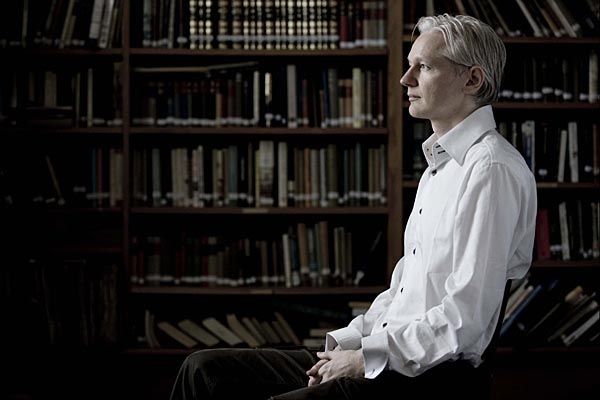
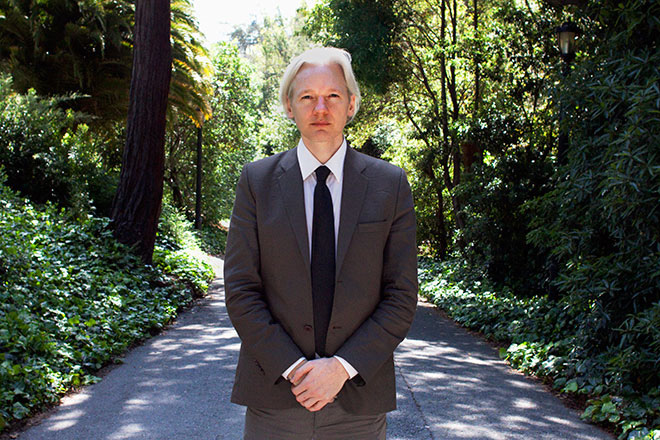
Spookiest photos of Wikileaker Julian Assange

Alone in a library

Holding a newspaper

On a road, surrounded by trees

Coming through a door

Wearing a lanyard

Big hair, big collar

The blog without a face.

Here it is, the blog that just kept rearing it’s head wanting to get out.

And here’s hoping the result’s not ugly.

My wife recently gave birth to a boy. That was my first shock. A boy. Just like me. Oh.

I can’t recall what I said at the time. I hope it wasn’t: “Oh. Will you look at that!”

I soon realised I hadn’t genuinely considered the implications of having a boy. (I don’t get why people find out the gender via ultrasound. You lose all the shock and awe. And that doesn’t just last the first few days. I’m still in it!)

Given a week staring at the adorable child, I realised the only new decision to be made was not about colours or clothes or toys.. in fact, the only choice to reveal itself as urgent was the one of circumcision.

To cut or not to cut? To slice or just pretend it looks nice?

Real information was hard to come by. Dr Google returned a range of local doctors happy to do it – this website has 2 pages of doctors happy to do it, just in Sydney – and fear-mongering sites supporting either side. What was missing was genuinely clear, unbiased info from a reputable source. The medical associations here and in the US offer tainted views that fail to cite research or, if they do, it is for one side of the debate only.

Sites claiming to be neutral offered up the furphies that a ‘vast majority‘ of boys don’t get circumcised’ or that no hospitals and few doctors perform circumcisions.

The Royal Australasian College of Physicians has this paper (PDF) on the matter. Of course, when I was a boy they had the opposite view and, now, with the general trend against the cut (as it has no immediate need nor benefit) the RACP also appear sceptical of any preventative benefit the procedure may have. That view surprised me, coming ae it does, despite circumcision’s widespread implementation in Africa to reduce STIs (The best thing I found to read on this part of the debate was here).

A website called Circinfo appears helpful and genuine but ultimately fails too in providing fair info without slant.

The site has a neat table of possible injuries a boy may incur – a valid concern – and one that points out how in 1919, one boy somehow got tuberculosis from his circumcision.

What? Why? I’m sure there were some nasty results of early forms of amputation too, or side effects from cough medicine that included strychnine, but I don’t need to be told them when I sign up for the modern version.

Circumcision is safe enough to have been performed in pre-biblical times so boys getting it done have a good long historical record predating Jesus by several centuries.

It’s easy to dismiss that fact but why is the procedure still around and so popular two millennia later?

For those are not up to date on how circumcision can work in these days of whiz-bang surgery, anaesthetic cream is now all that is needed, and after 20 minutes, a quick procedure cuts the foreskin off and your boy is good to go home in an hour, adorned with gauze. A little protective ring is left on – this falls off in a week. (The next day or two are typically days of pain and discomfort but breastfeeding does the trick in calming anxious babies’ nerves)

Yet some hospital websites haven’t cottoned on to these procedures yet and still recommend general aneasthetic, suggesting it is safer.

“Thus,” says one ill-informed Australian hospital website, “It is recommended that you wait until he is at least six to 12 months old because the operation and anaesthetic are safer then.” – Thankyou Sydney Children’s Hospital.

In contrast to this, the two doctors I contacted both prefer boys to be brought in before they are two weeks old. Who to believe? Research can prove anything, it’s all just trends and everyone has an agenda.

So I turned to trusted friends for their views.

That wasn’t much more helpful.

Nearly everyone fell into two categories:
1) We did it because his dad had it done. (Felt right)
2) We didn’t do it because dad didn’t have it done. (Felt wrong)

Decisions based on hunches didn’t seem good enough to me when those against the procedure were claiming it was an abomination, harmful, dangerous age at their angry worst, ‘barbaric’.

(If you want to lose credit in an argument, describe something most people do because it feels right, as barbaric.)

I was already heading toward getting my boy done, believing that the cosmetic reason many dads give was actually a genuine anxiety disguising a deeper sense of identity that is at threat between a man and his son. That, and I believed STIs are a widespread issue that could be dealt a statistical blow if everyone did this to boys at birth.

But one friend I talked to, a school office worker, had a thoroughly different view.

Her stance came from the experiences of parents at her school. “I could name six or seven families that have told me they have had to get their boys circumcised later on because of problems.”

The problems were infections under the foreskin and the boys were four, six and eight years old. This was not something anyone else was discussing.

This shocked me as it obviously meant that the boys would need a general aneasthetic – a much riskier proposition than a newborn circumcision.

The optional twenty minute procedure for a newborn had, for these parents, turned into an overnight hospital stay for their primary school boy and surgery that required a surgeon, an anaesthetist, a nurse etc. etc.

Plus, unlike a newborn, a four or eight year-old would definitely remember the pain that folllowed, and probably be left to deal with the shame of their friends finding out why they went to hospital… This was a very revealing chat.

The next revealing chat was with the doctor holding the knife.

The waiting room would have had twenty newborns pass through in the hour we were there. Apparently, doctors into snipping do as many circumcisions in one day as they can. This guy was heading for 100 plus in a day.

I was ready to grill him as I still didn’t feel I yet had the full story.

I asked how many older boys he saw needing to have it done due to infection. Ten per cent, he said. One in ten people he circumcised was a boy or man, not a newborn.

So, I was getting this done, firstly, for my boy’s one-in-ten chance that he might face it later without what I believe is the emotional mask of babyhood. This is what I call a muting effect, the precious grace a baby has to withstand a bump on the head, or a serious fever, and recall neither later in life, even a day later. Some deny this, fearing babies carry all trauma forward into life. I’m not one.

Secondly, I made the decision based on the identity issue. To have a son with whom I will share many traits, many not physical at all, is a special, special thing. To be lacking one similarity that is profoundly personal and how shall I put it, a centrepiece(!) of a man’s primal instincts, would add a bonding difficulty I would rather didn’t exist.

Lastly, I was at ease knowing the preventative value of circumcision I was providing my son. In a judgment of risks now versus risks later, I was glad to know the rate of STI transmission for my son would be lowered, as was his chance of passing on infections to a woman – even cervical cancer via the pappiloma virus – and, knowing I had removed, literally, his need to wash an area regularly to maintain personal hygiene.

We do preventative things throughout our life to protect ourselves just in case. They may not have been needed, and, moreover, we do them for our kids who may or may not agree. We’ll administer painkillers, antibiotics, provide the best available diet, teach them to ride, drive…

This was how I arrived at my decision.

And look, I didn’t even need to mention Elaine from Seinfeld’s quote:

“It had no face, no personality. It was like a martian.”
Elaine, describing an uncircumsized penis, in “The Bris”

Gillard plunges the knife – exposing Rudd’s humanity

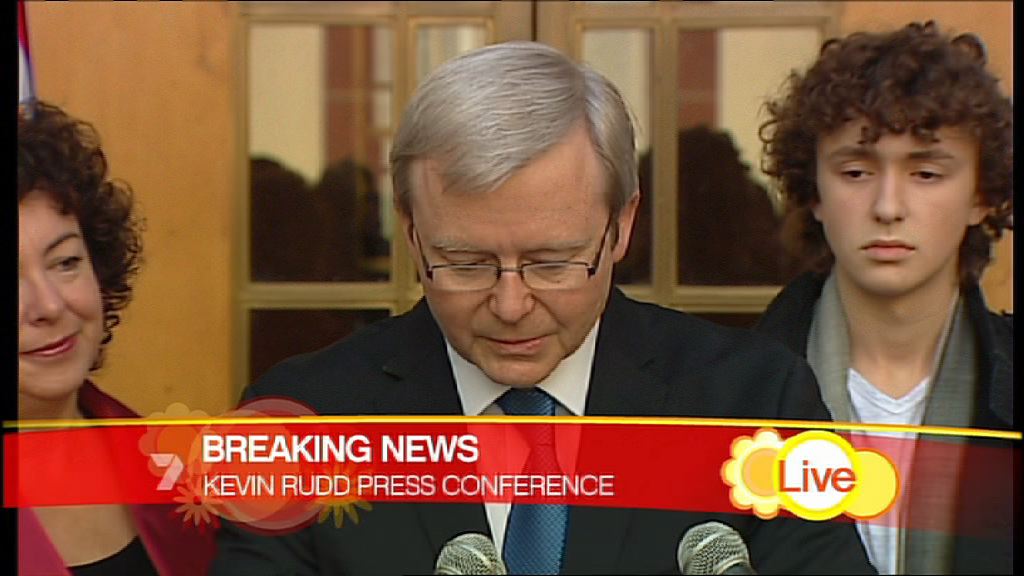
I met former PM Kevin Rudd during a Channel 7 forum organised by my Executive Producer, Adam Boland. I was impressed with Kevin Rudd’s determined approachability. It was the kind of televised event that could be taken as cynical and facetious but for those in the room at least, for those brief moments, we got what we all want to believe – that politicians are just like us, and that they actually like us.

As if to ram this point home, Kevin bounced up to my wife and daughter and I at the end of the broadcast. he spent a minute to discuss parenting and shared a quick story that he his children had ‘bumps’ on their head just like our baby did. We were self-conscious about our baby’s small forehead bump but the PM came down to our level and it felt entirely genuine.

It was classic Kevin.

My lovely baby bumps

Meeting Kev

During the forum, the questions flew at him like those glowing balls on Tron that you deflect with your frisbee. Rudd was a master with the frisbee.

Like every recent appearance on Sunrise, he had no warning of any question – he had to be on his toes, and he performed with class. Unsurprisingly, it was at the peak of his popularity.

When he was directly in front of voters, Kevin would not squirm his way out of questions like he did when in a studio battling the wits of a TV presenter.  He couldn’t avoid saying anything in particular, as became his unfortunate talent, using his stalling phrases ad nauseam – ‘Let me just say this’, ‘The fact of the matter is’ and the rest of them. Double-ugh.

He was a real guy. He was certainly a diplomat and could speak with programmatic specificity when he needed to, but when he was talking to Sunrise staff, or when he was on Rove, I thought Kevin was painfully real.

Ultimately, he was too real to be Prime Minister.

From what we hear he managed his staff like he was a McDonald’s crew trainer burning through teenagers who couldn’t meet unrealistic targets.

Perhaps it was the demanding reformist agenda that needed to burn through one leader along the way, I am not sure, but I think Kevin was a victim of being what we wanted in a leader – one of us.

Kev tried, often too hard to prove it. He quickly mastered twitter and told us what films he saw on the weekend. He said “Are we ready to roll, guys?” at the start of pres conferences. Last week he told Latika Bourke, a press gallery journo, that she had a nice scarf. Hell, he even appeared on Rove. Twice!

He was criticised for all those things. We want a real leader, but not too real.

Yet today, when Kev broke down in his farewell speech, he had us feeling he was on our level again.

Nice scarf, son

Nice scarf, son

Julia Gillard, Rudd’s replacement, is, I fear, what the job needs. A Politician.

Shrewd, precise, Gillard is like the colleague at Maccas who hits their targets every week. Hopefully she learns to have fun too – to be real.

But then – as I think we learned today – that would be asking too much of a Prime Minister.

How to Have a Baby with an iPhone

Having a baby used to be about getting to hospital on time and finding the right pain relief.

Whether you choose that route or to ditch both those options and have a midwife-attended birth at home as we did, the technology in your pocket could deliver a more delightful time for all.

The role of a husband in child birth is always unclear so in the run up, I devoted some time to picking out the best apps for research, managing and capturing the intensity of labour and then tools for broadcasting the good news.

For a variety of reasons we chose to have an midwife-attended homebirth. I consider it to be a brave choice and one that has enhanced my marriage beyond any other single experience.

But enough about love and how great my wife is pushing out a 4.5kg tele-tubby, the whole thing went as smooth ad it did partly due to my iPhone.

Here are the apps I used in order of their appearance;

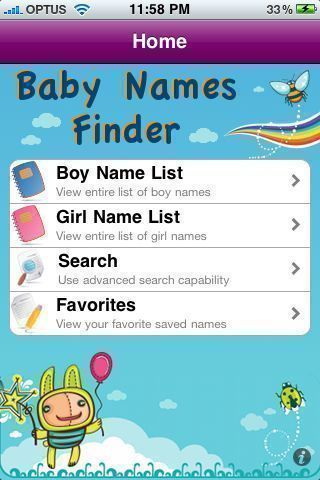
1. Baby Name apps
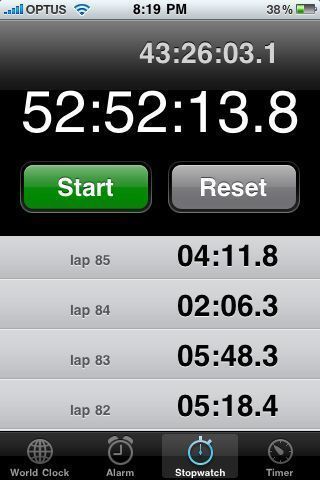
2. Stopwatch for contractions
3. Phone/SMS for contacting midwives/family/work
4. Photos for memories
5. Playlists for soothing tunes
6. Videos for shock & awe
7. Twitter for updates
8. Facebook/SMS/email for the announcement
9. Alarms for reminders

Notes on the use if these apps during labour;

1. Baby Name apps — we used four in all. Some were good for checking meanings, origins and others popularity. We developed a rule that anything in the US top 100 was off limits. No Jayden or Jesus for us.


2. Twitter for updates — I sent one for novelty’s sake when my wife woke me at 3.30am. See pic.

3. Stopwatch for contractions — invaluable. The native app has a lap timer enabling me to watch length of the surges and the time between them (see pic)

4. Phone/SMS for contacting midwives/family/work — I had promised my fill in that I would inform her when things got real. I cc’ed the staff set up to do my tweeting and my youtubes too. (no joke!)
5. Photos for memories — From lving room couch to floor to hot shower to soothing bath, the phone’s quick start-up camera meant I could get a few timely shots of different parts of labour without leaving the action.
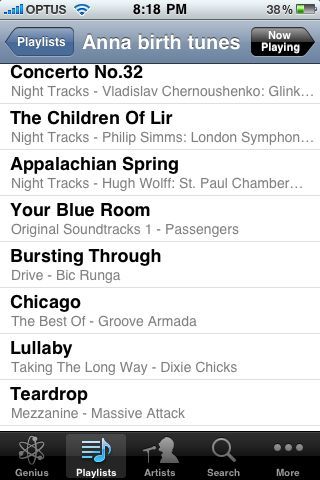
6. Playlists for soothing tunes — With tracks chosen weeks before (our baby was a fortnight overdue) we hit play on my wife’s birth tunes playlist of mostly gentle female singer-songwriters. I wish we had chosen three times more songs as the long labour meant there was much repetition. See pic.

7. Videos for shock & awe — Yuk. Who videos a birth? Well not me, until one midwife said ‘you can always delete it but you won’t get the chance to film it again!’ I agreed to capture bubba’s first moment on mum’s chest. Very glad I did. It was the biggest sense of relief ever.
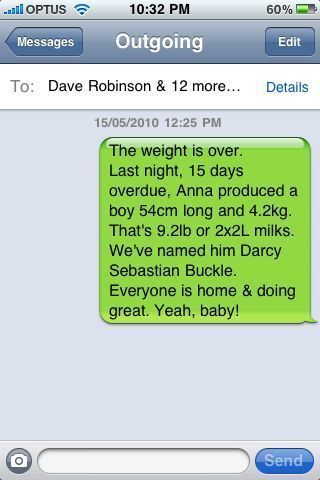
8. Facebook/SMS/email for the announcement — See pic.


9. Alarms for reminders — With wifey on some recovery treatments and herbal remedies in the hours and days following the birth, a few clicks and I have alerts set up to keep her popping pills and downing potions on schedule.

Despite the valuable contribution of my iPhone during the birth we chose against naming our child Apple.

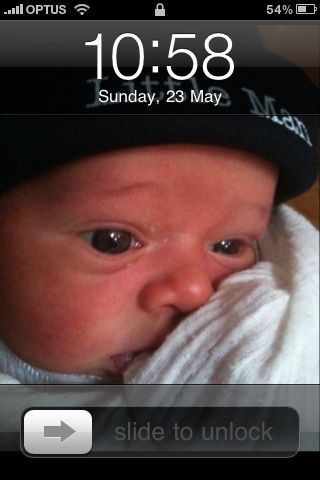
Catch a photo of Darcy as he is on my wallpaper below.

Speak

I am a nocturnal web producer based in Sydney Australia who’s also a church-going, iphone-toting family man with a life-threatening addiction to the Internet.

I am here under the — no doubt, misguided — belief that writing a blog might help and not hinder that situation.