It’s not me, it’s U2

Funny short legs don't you think?

The poster on my wall from the age of 12 through 16

U2, the band I grew up with, collecting their limited edition vinyl and attending every concert, are done. It’s over. They haven’t quit yet but I am confident they should, right after their next album.

In the same way it’s important to leave a party when it’s still going well – it’s time for my favourite band to die now. And I hope they do while they are still linked with the joy of their most profound musical moments.

I know the Rolling Stones announced this month that they’ll be quitting the stage, but that’s not reason enough for U2 to step down.

Oddly, my earliest memory of U2 is of knowing people wanted Bono to go away.

And those KILL BONO T-shirts I spotted 25 years ago are still on sale (Thankyou Internet)

To the point. Unlike Bono.

I’ve never hated the man. I have, at times, loved him. Now, a few things convince me their next album should be their last.

Bono has said that the band will quit when they release two crap albums in a row. Based on that theory, and following their last album No Line On The Horizon, their next album will be their final production.

The end began when U2 became stuck in a rut following the album Pop. Pop was dazzling, bringing together the inventiveness of Zooropa and the courage of Achtung! Baby, and drawing on every musical trick they had in the bag. Problem was, their creative energy was exhausted just as their core of fans began to lose faith.

As a songwriter, Bono has mined the poetry and narratives of the Bible better than any other pop star. His decision to stop this brought him to a personal crisis. Could he really hide the part of himself that paraded his Christianity throughout their early albums? (Could anyone expect to hide a messianic complex?)

We broke the bread, we drank the wine, everybody having a good time… Except you. You were still talking about the end of the world.

Until the End of the World

The band claimed that the mega-hit LP Achtung! Baby was the sound of four men chopping down the Joshua Tree, yet lyrically, the album was as full of biblical metaphors, just as any previous album. It did, of course, add industrial rhythms and spunk that had been missing and it stands out to most people as their best.

For me, the turning point came in the disappointing album All That You Can’t Leave Behind, which lacked sincerity, depth, and left us with the most radio-friendly/nauseating song of its time, Beautiful Day.

Elevation was the height of the nonsense…

A mole, living in a hole
Digging up my soul now
Going down, excavation

Elevation

The magazine Uncut said it best in their review, pointing out that U2 appear unable to write a song without an explosive chorus — think about it, it’s in nearly all their songs … and once the build up and climax is identified, it’s painful inevitability proves it a predictable, manipulative tool.

To be fair, songs like One and With or Without You are the exception.

There were reports around 1995, that the band had thrown out an entire album of songs only to start again from scratch – something they have a history of doing. They repeated it before the last album they released, No Line On The Horizon, when they not only sacked their producer but trashed an entire series of songs said to be taking them in a new direction. Instead, what we got was an album that avoided explosive choruses yet delivered confused tunes, some of which, I believe, lack a chorus altogether.

Mediocre reviews were only the half of it. When the band launched their latest hugely successful ‘360 Tour’, Bono’s voice was dead on arrival. I’ve just watched their DVD concert recorded at the famous Rose Bowl stadium. The stadium is packed and the stage looks phenomenal, but if this was the performance they thought deserved to be captured forever on film, I’ve got a feeling it is also the last one they’ll capture on film.

Dutifully, I went to the Sydney concert for the 360 Tour, and like the Vertigo Tour before it (pictured) the stage was an engineering marvel.

Childhood dream – tick.

Like many U2 fans still gripping on from the 80s and 90s, I continue to buy every album and attend every tour — a loyalty which puts enough money in their bulging pockets to make anything the band do look like a success.

But this loyalty conveniently disguises the fact their concerts are increasingly reliant on their greatest hits. At the last two concerts, I’ve been embarrassed to find, even a few rows from the stage, that no one is singing any of the new songs.

When the night takes a deep breath,
And the daylight has no air,
If I crawl, if I come crawling home
Will you be there?

In a Little While

I’ve read a few books on the band, and one early biography had great insights into U2’s belief in the power of a song. They don’t ever underestimate the ability of one pop song or one performance to transport people into a different mindset and a better life (if only for a few minutes). What’s even more powerful, Bono said, is that a rock song can change people’s minds and have them believe they can change the world.

He’s right, this time. I do think U2 have changed the world outlook of many people.

But that was years ago. I have been more loyal than most but now, even I must acknowledge that the exhilarating moments U2 brought me, the times I felt no other group could reflect my thoughts so well, were back in the 1990s – 15 years ago.

What’s left for U2, except to taint their legacy and possibly undo all the joy with crap pop songs in search of a chorus?

I don’t want to KILL BONO, but I do hope U2 die.

Apps beat tasks, but not taste

Smartphone apps – mainly free ones, bless them – continue to change my everyday routines, enhancing once mundane duties into short, fun tasks.

For instance, I can find and launch apps to change channel on my TV and adjust my stereo quicker than I can locate the remotes needed to do both.

I use an app to record wine labels and tag how enjoyable they were much more easily than I can recall them.

And with nifty little Instagram I can enhance photos and share them much quicker than I could ever launch Photoshop and email pictures of my coffee to a bunch of strangers.

But I am running out of worthwhile things to share. And I am asking myself more and more, why are we all sharing photos of our coffees? Sure you might be excited by the smell and the unique design doodle in the latte froth, but all we see is a coffee. Like a meal, it’s a multi-sensory experience, not a visible moment. You’ve dumbed it down and crowded my feed – pardon the pun.

An occasional, extraordinary meal, sure… Tell me all about it so I might cook it or visit that restaurant. But snack food? A good espresso?

Then comes new app EVERNOTE FOOD. (link: http://blog.evernote.com/2012/06/07/everyone-to-the-table-evernote-food-for-android-has-arrived/)

“With Evernote Food we’ve created an absolutely beautiful way to preserve every dish, every table, and every bite you’ve ever had.”

Now you can capture the time, location, menu and photos of your favourite culinary experiences.

This app will even link your meal with other items you have saved in generally awesome notebook app, Evernote.

(It’s free and seriously good. Get it.)

“For example, if you used Evernote Hello at a lunch meeting, the faces of the attendees may be associated with the Meal.”

What a hideous thought.

And as you will find if you put all this effort in with Evernote Food, your meals are now shareable. So not only can you record every meal in detail, the menu, service, location and attendees, you can also tell everyone who wasn’t there!

Here’s an idea. Don’t.

Best Questions asked of Mr Abbott on #AskTony

When Tony Abbott made himself available via Twitter this afternoon to answer questions, the social network let loose like a classroom left alone with a casual teacher.

That’s not to say it wasn’t enjoyable but real questions were few and far between.

I, for one, support the idea of such real accessibility. Let’s hope we see more of it from our politicians – because as long as it’s a rarity, it’s only good for entertainment value….

@kinnasurprise “What is love?” #asktony

@BiancaSteman why do you have to be so mean #asktony

@GeorgeBludger: does my black hole look big in this? #asktony

@benpobjie: Why so grumpy, Grumpybum? #askTony

@HelenRazer: Have You Ever Seen The Rain? #asktony

@albericie: When will you accept our invitation to do an interview on #lateline? #asktony

@Chriswhitewrite How many roads must a man walk down? @TonyAbbottMHR #AskTony

@Chrys_Stevenson Are you a folder or a scruncher?#toiletpaperquestion #asktony

@Gwillotine: #asktony How’s Malcom?

@ana_au_: Do you really want to hurt me? #asktony

@AndyofSuburbia Butter or Margarine? #asktony

@maevegobash: Which douchebag staffer told you that doing an #AskTony thing on twitter would make you seem hip and approachable?

@RupertMurdochPRHow @TonyAbbottMHR is it possible for Australia to have the “worst prime minister ever” and yet you are less popular than her? #AskTony

And this piece of platinum Twitter as Mr Abbott signed off…
@RobJamesBoN My planet needs me. RT @TonyAbbottMHR: Sorry. I have to go now but thanks to everyone who responded #asktony

Commbank says ‘A Man Is Not a Financial Plan’, but…

Blog.Commbank is a company blog by the Commonwealth Bank. And good on them for trying to make finance a bit more palatable.

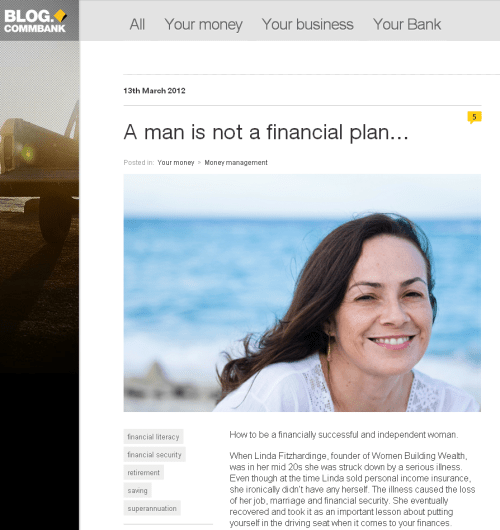
While looking around, I was a bit surprised to see a post titled A man is not a financial plan…

Sharing

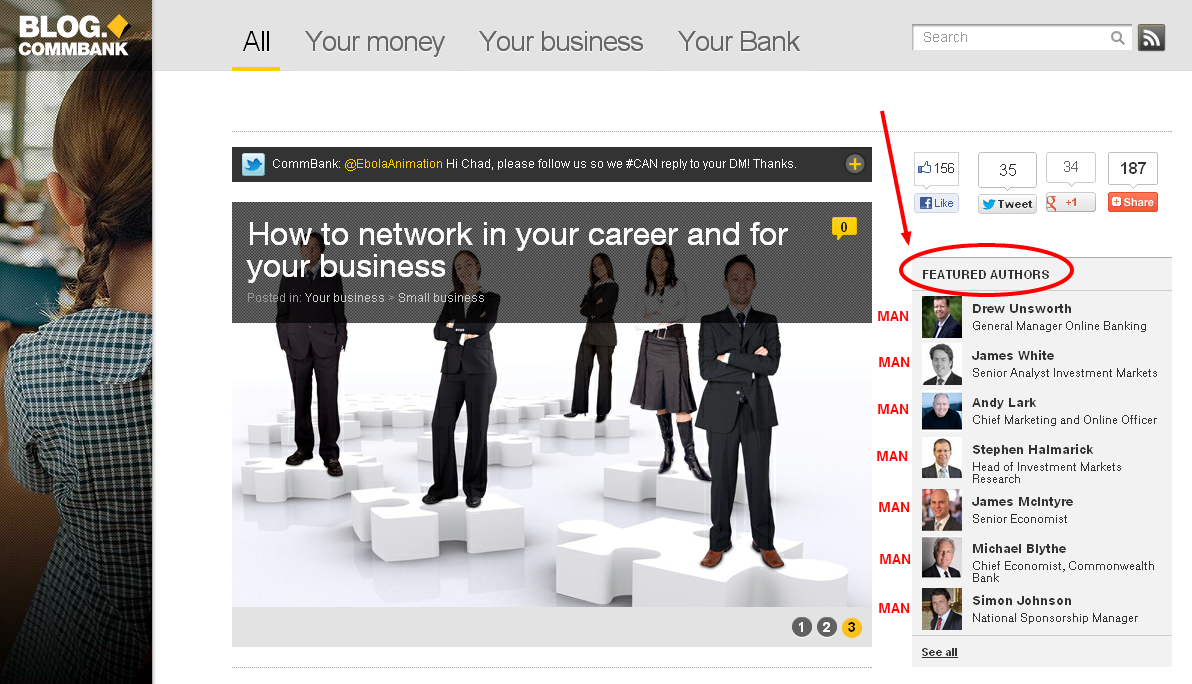
But I was a bit more surprised than when I clicked back to their homepage and saw who writes all their blogs…

All men…

Wo, man.

This is on the blog’s homepage. So, they’re not trying to hide it.

Getting a woman on staff could be a good plan

Also to the CommBank’s credit, they respond to comments left on their blog posts. Like the response to the woman complaining the above post about relying on men was patronising to women. Their response says, “This is actually a true story, based on the real life experience of a woman who should have known better…”

For a blog that seems to be targeting women (other posts include High tea With Maggie Beer, and Know an Incredible Business Woman? [sic]) they should probably know better.

Addendum

When you click ‘See all‘ just below the pictures of seven male authors, it reveals two women are in the full list of 13 employees asked to write blogs. So there’ s that.

Filtering, favourites, lists and real clout on social media

Filtering

Social networks need filtering. If this issue is not sorted soon, places like Twitter, Facebook and Pinterest could eventually become ghost-towns. (It could happen. Do you really think you’ll be posting this often in the same places in five or ten years?)

Imagine if 80% of posts in your feed were the gold you want to respond to, the ones you’ll laugh at, the posts you actually want to read. Of course, we still need at least 20% to be slightly irrelevant so distract/potentially inspire us.

That’s the well-filtered world we could be living in now, if we could just figure out who to follow, who to prioritise and how to manage it all.

Currently, networks like Facebook present us with more options than a food court.

Friends, Photos, Events, Apps, Lists, Subscriptions, Groups, Pages and soon Timeline Advertisements… It’s an untameable beast.

We require simple, effective filtering to
lessen the burden of just maintaining what was once so enjoyable to engage with.

Clout

To this end, the idea of measuring clout – to show who are the most influential people on a social network – could be endlessly useful.

I’ve seen many stories about why Klout.com is feted as a measure of social capital. And it does seem a vaguely accurate marker – however easily manipulated.

But I have read other claims it’s based on a misnomer. After all, say the critics, “how do you define influence?”

Here’s how… Lists. Twitter Lists.

Lists

Do you add anyone to your Twitter lists who you don’t respect? It takes longer than to follow someone, and you only look at it for a specific purpose, not while window-shopping on your general twitter feed.

I am on about 60 people’s lists, because I have little influence. (It’s ok. I don’t feel bad.)

Barack Obama is listed 170,271 times. And rightly so.

Secondary to how many times you are listed, is who has you listed. Do they have many followers? Are they listed many times? This could also form a way for Twitter to select top posts. Currently, that algorithm seems hooked on a user’s number of retweets and follower numbers.

Mashable says that there’s a need to quantify someone’s ‘reach, relevance and resonance’ to measure their social influence accurately. (Read more of this dubious claim.) However, influence is dependent on subjective reasons too, like likeability – for example, Barack Obama is of much less influence to you if you are a Republican, or if you live in Iceland.

Favourites

Just a quick note on this much ignored feature of Twitter. I love them as a bookmark, as something to retweet or reply to later… They have many uses. But… they’re UNPROTECTED.

I can look at your favourites, you can look at mine. This astounds me. Can you see my browser bookmarks? No. Yet, without even logging into Twitter , I can see that;

  • Demi Moore has added to her favourites a string of tweets about cheating and moving on from mistakes
  • TV Newsreader Pete Overton likes to add a favourite star to compliments of himself (admittedly, something many of us probably do).
  • PM Julia Gillard used to save criticisms of her staff
  • Singer Rihanna favourites 140-character profane mantras (to turn into songs?)
  • Broadcaster Mark Colvin (@Colvinius) stars what are probably research for future stories
  • Model and TV personality Sarah Murdoch has two favourites – and one is just creepy.
  • ABC Managing Director Mark Scott saves stories related to the changing face of journalism
  • Opposition Leader Tony Abbott has saved just one tweet to his favourites – and it is one of his own. “@ozleaks Didn’t see the programme but, yes, humans have evolved”

Obama’s campaign – no longer a font of wisdom

A quick typographical look at Barack Obama’s second presidential campaign, so far.

When Barack Obama’s first campaign appeared it was all strength and clarity. The HOPE poster made him and his message iconic. For some, the arrival of Barack Obama in American politics was nothing short of messianic. Now, with Obama facing a second-term showdown with Republican Mitt Romney, comes this…

Your President is now embracing into shabby-chic and oil burners. He wants you to feel warm in your own home – but not with strong leadership, diplomacy and economic stability but with Ugg boots and personalised Snuggies. This looks like something pinned by a pastel-wearing scrapbooker on Pinterest. Surely a message can target women without using mint green?

But it’s not just the feminised approach Obama is taking that is bothersome. His messages are clouded by so many different typefaces that any thread is lost amongst all the marketing tactics they are throwing up.

This poster is obviously not too big to fail. I can’t read it without concentrating closely. The multiple fonts are a mess and it feels like an optometrist’s test.

This is about as far from ‘presidential’ as it gets.Feels like an online t-shirt shop. (So I guess it got that right.)

Slick cases with the chunky block serifs evoking competitive NFL and NHL teams. So, it’s a youthful brand but still a bit combative. I like it. Click pic to see more in the store.

This one doesn’t even mention Obama by name. Reminds me of the woven badges I used to collect as a kid.

Standard Obama typeface in three different versions. And presented like bunting usually seen at a convention or a sporting event. George looks like he needs a Nespresso.

Oooo, that’s clever. And no doubt enough to convince some young voters that Obama is in fact Irish.

This is the most surprising use of frilly fonts to me. The titling of the event looks to be lifted from a cheesy royal wedding mug or the movie poster for a romantic comedy. I realise they are friends but this is taking it pretty far, even for a campaign clearly looking to target women

This underlining and alternating fonts – serif to sans-serif – is a familiar tool the Obama team uses and is brought over from the Obama HOPE campaign. You can scan it and immediately get the big points. What’s new is the rain, which tells us he is steadfast, embattled and he likes Kevin Costner films.

Next week: Romney employs bubble fonts.

Searching for Australia in Koaland

Shopping for souvenirs in Cairns – a world away  from the nearest koala, emu or sheep.

I enjoyed reading a piece by Nick Bryant on Australia’s national identity and how it has been misshapen through our self-reflective cliches. The way we call ourselves ‘Down Under’ to Americans is cited as one example of how we tend to belittle ourselves. (I would add that our failure to put Americans in their place when they use the term also shows a tendency to ignore our success and pride.)

Nick’s article included this paragraph to help explain our fond attachment to phrases most of us don’t even like or use …

…as the database at the Australian National Dictionary Centre in Canberra reveals, “She’ll be right” gets at least two outings a week in Australian newspapers, while “Tall Poppy Syndrome” has been a weekly fixture for years. As the Centre’s director, Sarah Ogilvie, notes: “People are still using phrases which to an outsider seem anachronistic.”

Nick is a talented journalist whose biography shows he has moved regularly during his time as a foreign correspondent.  Nick’s decision to stay in Australia since 2006 shows, I believe, his admiration for our country, plus some sense of hope in our future. If you thought our best years were behind us, you wouldn’t move here. You would just visit, grab some souvenirs, then head home to where you belong, right?

I have just returned from a week in Cairns, in Far North Queensland, where the souvenirs tend to define a city having its own identity crisis. Stifling nostalgia is passed off as a historical discovery tour. Surreal caricatures of our fauna trivialise any natural beauty that lies outside our cities.  If you subscribe to my Facebook Feed, you would have seen my gallery of the region’s eclectic architecture and other oddities but neither of those begin to explain the schizophrenia  Cairns suffers trying to balance as a home for locals and as an international tourist destination.

As Cairns tries to position itself as the first stop for Asian visitors to our shores – something record airport arrivals would suggest it is doing very well – what greets visitors is a parade of tackiness and a clichéd approach to our emblems, wildlife and culture that presents an Australia unchanged since the 1960s.

Here is what confronted me on my first wander through the town centre; Opals, Ugg boots, koala backpacks and, for when you feel peckish… emu jerky.

Which of these resonates the most with your knowledge or concept of Australia?

Opal shop owners are doing us all a disservice. The romanticised depiction of a man down a mine grabbing a precious stone has kept Sydney’s The Rocks alive for much too long. It’s a tragedy that Cairns is going the same dusty, irrelevant way. Few Australians will ever head to Coober Pedy, and just because even fewer tourists will, doesn’t mean we should shovel such a flawed idea of mining down their bejeweled throats. Yes, we are the world’s largest producer of opal – being responsible for 95% of production – but most of it comes to us not by a rugged man in King Gees and a torch-helmet but like this…

…especially the opals coming out of Queensland.

Ugg boots are a peculiar fashion statement, at best. Wearing Ugg boots in Cairns – as I am told people do when the temperature drops below 20 degrees Celcius – is truly gormless. Trotting out Uggs and sheepskin rugs is also a quaint throwback to an age before polarfleece and cotton blends, when we were all wrapped in wool because there was a shearing shed down the road. But the fantasy must stop that put Australia forward as a sheepish, agricultural economy built on grazing animals for which the export market is rapidly dwindling just as the our ownership of the word ‘Ugg’ is under threat.

No Australian would think of skinning a koala, let alone wearing one on our back. The myth of the ‘Koala Bear’ should really have died off along with Matilda, the winking kangaroo inexplicably wheeled out at the Brisbane Commonwealth Games in 1982. Let’s be honest with our tourists – most people who manage to see a koala find it snoring and if they choose to hug one of the heavily clawed, disinterested beasts, they had better not be in NSW or Victoria where it is illegal in Victoria for anyone other than a Koala’s handler to hold them.

As for emu jerky…

There could be no more superficial Americanisation of Australian wildlife as this. Jerky is a US fascination and employing our national emblems to enjoy a salted chewy treat makes me sick for all number of untreatable reasons.

Cairns used to see most of its tourists arrive from Japan, however China and Germany are now the biggest contributors to the local tourism industry, no doubt due to the relative strength of those two nations. I was surprised to hear German used as the second language after English to give instructions on the Scenic Kuranda Railway.  Likewise, many signs in the town centre are also displayed in Chinese. The local paper, the Cairns Post, reports peak tourism bodies are striving to bring Chinese flights direct into Cairns which would send arrivals from our biggest export market into the tens of thousands per year.

So far, the nation we feel safest putting forward is still tied to the outback and way out-of-touch.

Will we present the world with a decades-old view of our nation’s brightest points; one of a dusty rural paradise where so few drovers actually roam and precious few miners dig for opals by hand, or will it be one that shows off our colours, talent and enthusiasm for life, exhibited in our stunning capital cities and across countless regional centres each with their own appeal? Let’s promote the brands and outfits we stand by, the artists and home-grown designers we know by name. Let’s leave The Kens behind. Ken Duncan and Ken Done, your time has past. Our tourism has become entrenched in a dated value system that elevates our strange marsupials and landscapes above our achievements as a wealthy, warm people who have accepted millions of migrants, built glorious cities, a diverse society and a robust national economy and we will happily share our glorious nature with anyone who visits.  We will even let some of them stay.

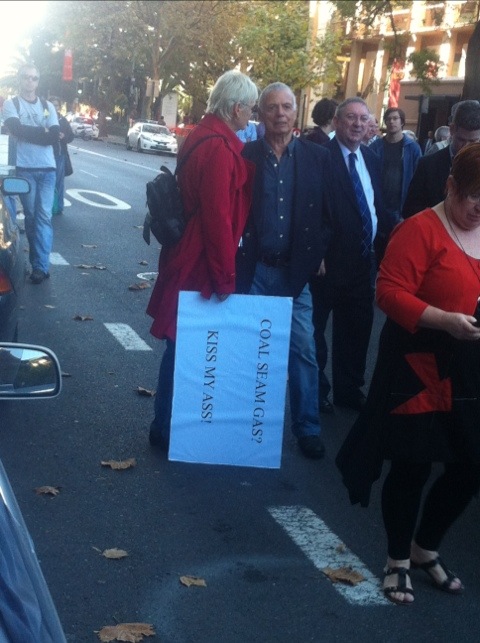
Best signs from Sydney’s Coal Seam Gas protest

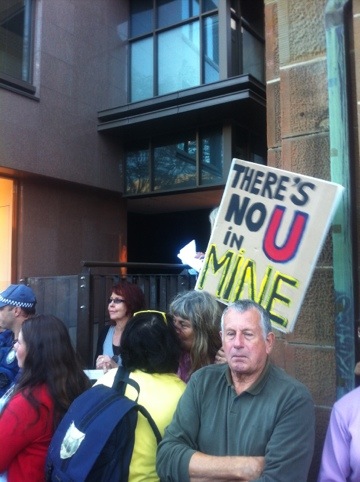
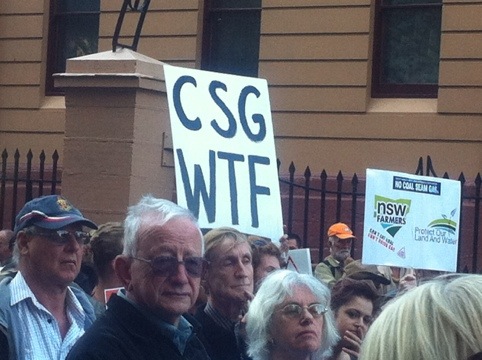
Most people’s signs at this event were clearly provided to them and featured the amusing NO GAS slogan, held aloft as if it were a personal accomplishment.

But as I wandered through the crowd I noticed a few original ideas, soni decided to snap them.

Impressively, I think, the obvious FRACK OFF was nowhere to be seen.

20120501-130819.jpg20120501-131045.jpg

20120501-131624.jpg

20120501-131648.jpg

That awkward moment when Social Media appears on TV

If the addition of social media to a broadcast is not intended as a distraction to the main game, why is that so often the outcome?

This is something I have wondered as I look at Australia’s attempts and those by networks around the world.

I thought it was self-evident that viewer opinions, when integrated into a television programme, are there to enhance the primary content. But perhaps the pendulum has already swung too far.

Why is it that many shows that have tried out social media on-air are not using innovative techniques, not conjuring up their own clever use adaption of this new community, but instead throw up some clunky graphics or even use the frustrating ‘stop/read a tweet/continue with show’ method.

Exactly who benefits from that?

Poor implementation risks offending both sides. It shows those on social networks that you don’t understand how the stream flows relentlessly on, while those who’ve never signed up for Facebook or Twitter are peeved that their show has new awkward, trendy interruptions.

Good implementation can keep viewers hooked and boost ratings – The Voice in the US is seeing a great response from their use hosts and judges live-tweeting and responding personally to viewers.

One reason TV shows should and are trying to bring social media into the foreground is fear. It’s the fear of any switched on executive producer that the social media stream will become more entertaining than the show itself. People will watch their second screen (mobile devices) more than their first (TV).

Certainly, there’s no better influence for you to switch channels than if all your friends and those you follow are tweeting about #TheVoice.

Hence, broadcasters all over the world are battling with how to bring the social stream into the live TV event. They need to show viewers they are listening to their views, but some integrations of Twitter, especially, are wearing very thin.

I like the UFC‘s approach – use social media to build up hype for the event a week out. Have your main talent interacting with viewers on various platforms throughout the day and then following the event. They understand that owning the conversation is more about taking people in behind the wall of the TV screen than it is the chance to display a highlight reel of the sharpest or fastest tweeters.

Sadly, I think Australia’s one-time leader in this area is now dragging the chain.

QandA is making a mockery of what has become known as Social TV. The show, which can still command large audiences, has long held the torch for social media integration in our country.

Several programs still limit their social network integration to a back-announce of their hashtag as the show ends. (Bit late guys!)

(Lateline is the main offender there, but, I should say, I like the show’s latest idea to give a political or topical personality the reigns as ‘Guest Tweeter’. If you’re going to tell people to “join the conversation”, it makes sense to lead it. This limits carping and provides a loose thread people can join if they wish. If not, your hashtag is just an invitation for everyone to ‘Shout! Now!’)

But back to our beloved QandA.

Each week, an increasingly silly list of tweets are flipped up on the screen.

These days, it’s hard to spot any comment that adds to the discussion. Intelligent questions? Fact-checking? It’s more a procession of punch-lines that would never be appropriate to be read out loud on the show.

It’s more a ticker of sniping, witty retorts and clever word plays that often denigrate a guest. Cardinal Pell was a good example. As was John Howard…

It’s a technique that’s not showing the best side of Twitter, nor is it helping boost engagement for the audience watching at home.

Viewers, as a result, must now tolerate these tweets interrupting the actual debate, on top of Tony Jones’s regular interruptions of panelists (something he’s long been known for). Who benefits? No one but the wise guys who – no doubt – congratulate each other on their televised tweets the next day over the ad agency water cooler.

Imagine the real-life equivalent; You’re in a pub trying to enjoy the footy but you can’t hear the commentary because all the biggest smart-arses in the room have lined up to whisper their witty interjections in your ear.

Tweets that flash up and then disappear only adds to the distraction. (It’s very hard not to look at them. I tried hard and only skipped two. Tell me how you go.)

How about a ticker that continues scrolling in the bottom third – that way I can dip-in if I wish?

But how about some more creative uses of social media?

Get your hosts to tweet LIVE on air and ask for responses.

Give characters in a drama series real-life accounts, updated mid-week, to add to the storyline – and intrigue. (Packed to the Rafters recently started a character blogging – an interesting move.)

Contests can be easily managed via social media. Tweet your trivia answer to this hashtag… Find and LIKE our hidden Facebook page for the next clue… Start a Pinterest and name a Board after our show (Microsoft and Harrods have each tried something similar)

Philosopher Alain de Botton said that the main challenge of smartphones is for us to be more interesting than they are – to stop people’s eyes drifting back to their tiny screen.

The same goes for TV.

There are many ways we can take this Australia. Let’s not leave it as it is. Please?

Pretty soon, my second screen will be much more interesting than my first.

Zero-sum game: Why Coke wants you to switch

If you are like me you only drink Coke every once in a while. But recent television ad showing a cinema attendant who switches drinks on patrons still has me annoyed.

It could be the teenager’s smarmy style or it could be the fact that he’s failing at the one task he has now that the collection of movie tickets is largely automated. But the real problem lives in Coke’s attempt to change people’s habits because of rising commodity prices. It’s no surprise they want to save money and, as this graph shows, sugar prices have risen threefold in the last four years.

I actually think Coke Zero tastes fine and nobody needs the six teaspoons of sugar. So my question is why have we been dealt at an unhealthy alternative for years?

You can be sure that sales if Zero are set to climb in line with Coca-Cola’s ad spend, as the popularity of the regular drink starts it’s gradual decline into obsolescence.

(Surely, the sugar-free version will eventually become the standard version and, in a flurry of good PR, people will applaud what is really a cost-saving move cloaked as a health-conscious rebranding exercise.)

But, there’s a sting in the tail.

If the anti-sugar advocates are correct and sugar is an addictive ‘poison’, should we now expect to see a slump in sales without this lethal ingredient to hook in weak-willed soft-drink consumers?